SEO vs AEO vs GEO: Why Good SEO Is the Foundation of AI Search Visibility
Search is changing. People are no longer relying exclusively on traditional Google search results to find information, compare products, research services, or make purchasing decisions. Increasingly, they are asking questions directly through AI-powered platforms such as ChatGPT, Claude, Perplexity, and Google’s AI Overviews.
Instead of searching for “best digital marketing agency in Singapore” and opening ten different websites, someone might now ask ChatGPT, “Which digital marketing agency in Singapore is suitable for a small business with a limited marketing budget?”
The experience is different, but the underlying need remains the same: people want relevant, reliable, and useful information.
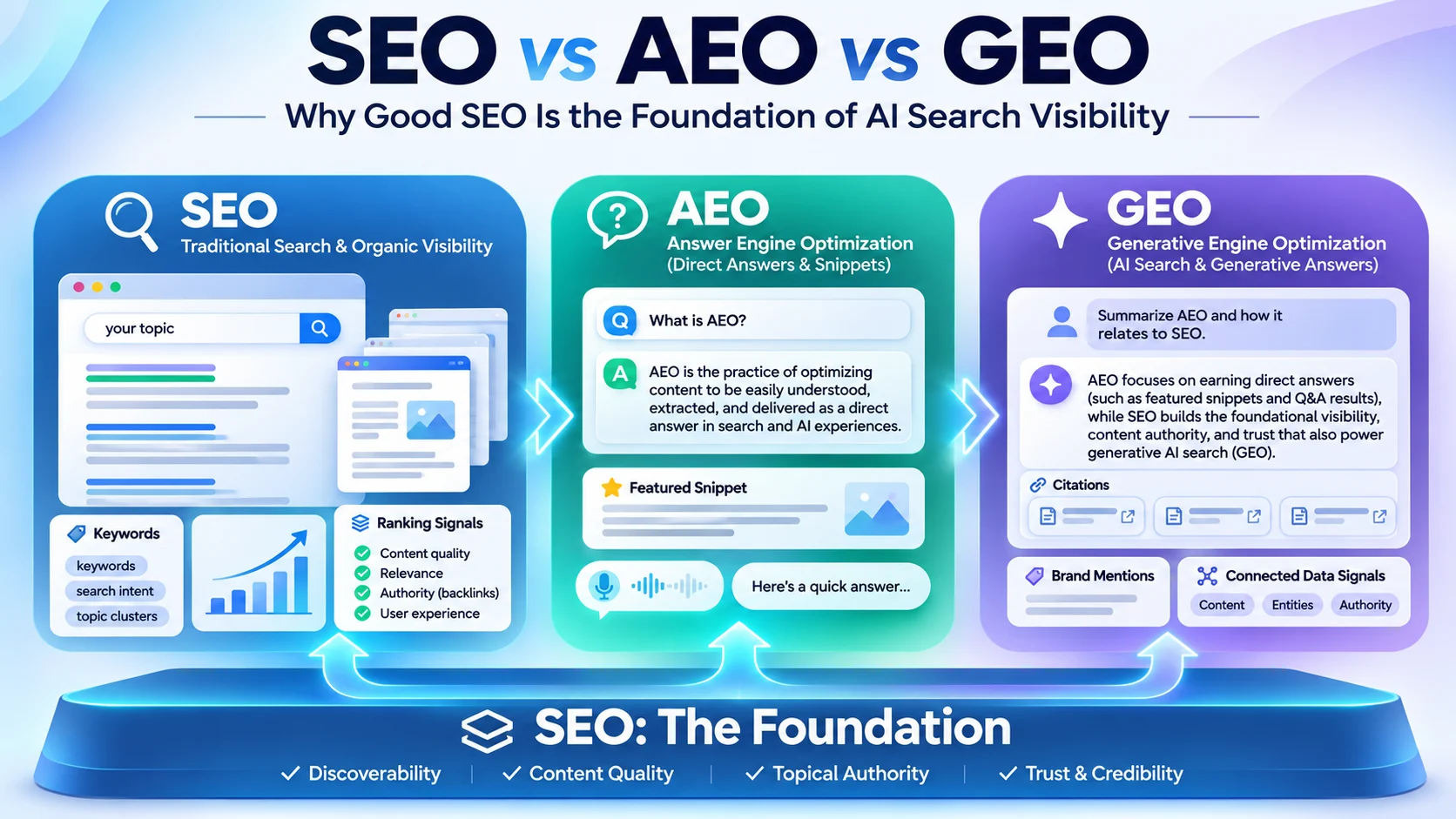
This shift has introduced three increasingly important terms in digital marketing: SEO (Search Engine Optimization), AEO (Answer Engine Optimization), and GEO (Generative Engine Optimization).
Some marketers treat these as three completely separate strategies. Others believe that traditional SEO is becoming less relevant because AI can generate answers without requiring users to visit websites.
Both assumptions miss an important point.
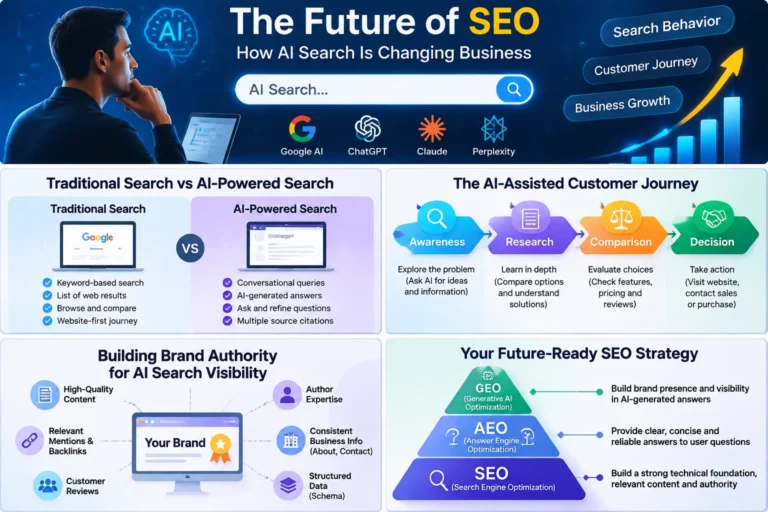
SEO, AEO, and GEO are closely connected. They address different ways people discover information, but they share many of the same foundations: useful content, technical accessibility, topical relevance, authority, trust, and a clear understanding of user intent.
In fact, a website with strong SEO foundations is already better positioned to compete in answer engines and generative AI search experiences.
Good SEO is not separate from AEO and GEO. It is the foundation that makes both stronger.
Let’s explore how these three approaches work, why they complement one another, and how businesses can build a unified strategy for long-term search visibility.
What Is SEO? Understanding the Foundation of Search Visibility:
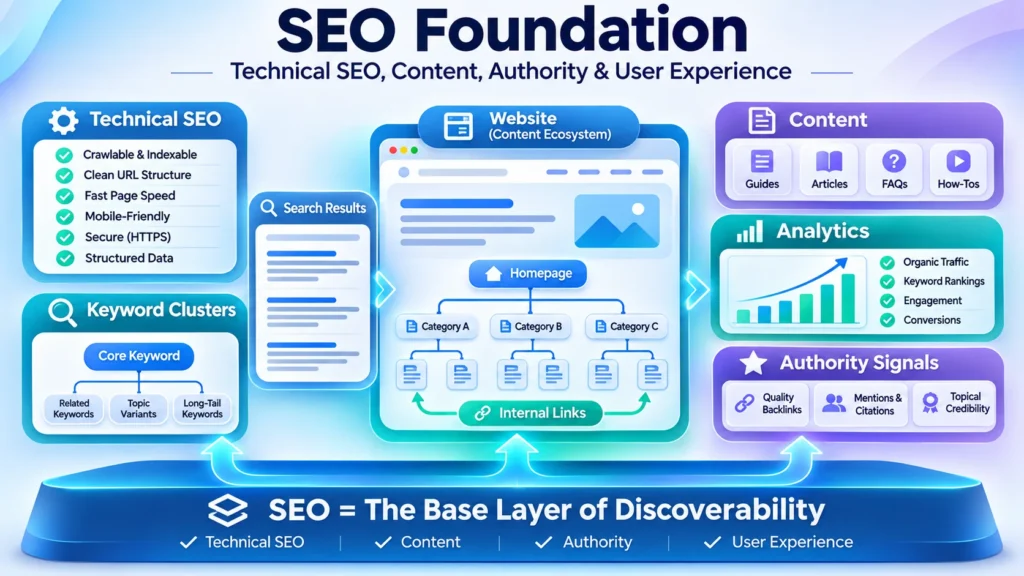
Search Engine Optimization (SEO) is the process of improving a website’s visibility in unpaid search engine results. It involves making a website easier to discover, understand, index, and evaluate while providing content that genuinely satisfies what people are searching for.
Traditional SEO is often associated with keyword rankings. However, effective SEO goes far beyond placing keywords in page titles and paragraphs.
It involves several interconnected areas:
- Technical SEO: Making sure search engines can crawl, render, and index important website content.
- On-page SEO: Optimizing titles, headings, content, URLs, images, and internal links.
- Content SEO: Creating useful, relevant, and comprehensive information that matches search intent.
- Off-page SEO: Building reputation and authority through relevant backlinks, brand mentions, and external recognition.
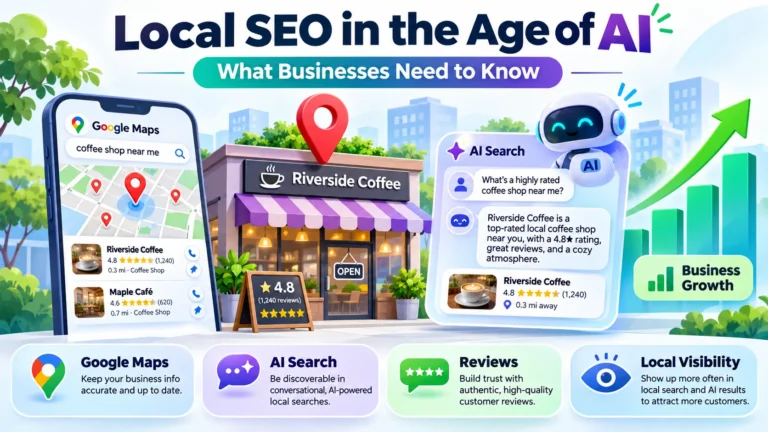
- Local SEO: Improving visibility for location-based searches through Google Business Profile, local content, and consistent business information.
- User Experience: Making websites accessible, easy to navigate, mobile-friendly, and useful.
Consider a practical example.
Imagine a plumbing company in Singapore wants to attract customers searching for kitchen plumbing services.
Simply publishing an article titled “Kitchen Plumbing Singapore” will not automatically make the company visible.
The website needs to explain the services available, common plumbing problems, installation processes, pricing considerations, service locations, and how customers can request assistance.
It also needs clear navigation, relevant service pages, appropriate internal links, and a technically accessible website.
When these elements work together, the business creates a stronger foundation for organic search visibility.
That is what SEO should accomplish: connecting the right information with the right audience.
And importantly, this same foundation becomes useful when AI-powered platforms look for information to answer people’s questions.
What Is AEO (Answer Engine Optimization)?
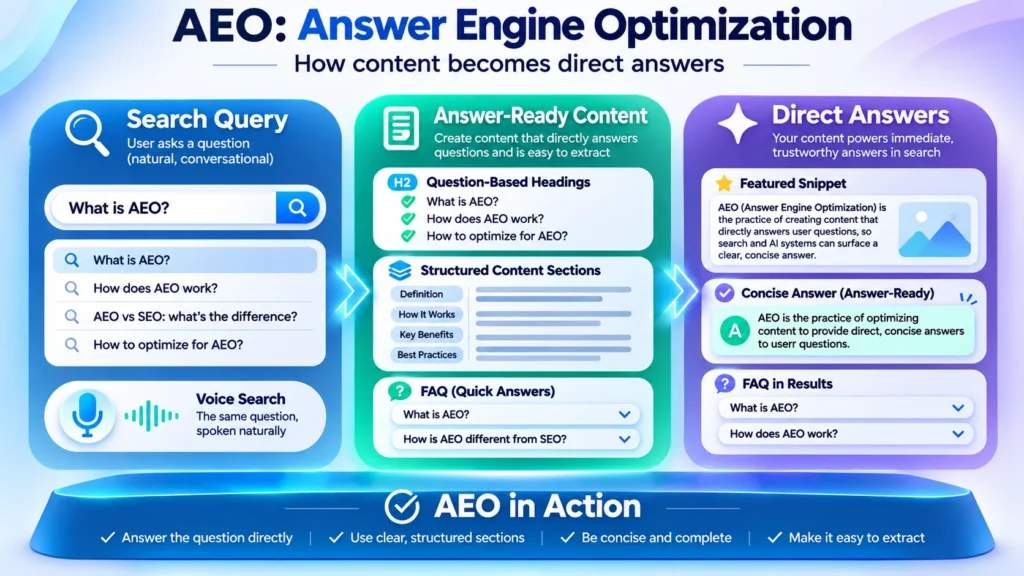
Answer Engine Optimization (AEO) focuses on making content easy for answer-oriented platforms to understand, extract, and present when responding to specific questions.
Traditional search engines commonly present a list of relevant pages. Answer engines attempt to provide a direct response to the user’s question, sometimes using information from multiple sources.
Examples include:
- Google’s featured snippets and other direct-answer search features.
- Google AI Overviews.
- Voice assistants and conversational search experiences.
- AI-powered answer platforms that retrieve and summarize online information.
The central idea behind AEO is straightforward: create content that provides clear, accurate, and useful answers to real questions.
For example, someone searching for a TV mounting service might ask:
“How much does professional TV wall mounting cost in Singapore?”
A traditional SEO article might target the keyword “TV wall mounting Singapore.”
An AEO-focused approach goes further by directly answering questions such as:
- How much does TV wall mounting cost?
- Can a TV be mounted on a partition wall?
- What wall types support TV mounting?
- How long does professional installation take?
- Should I hire a professional TV installer?
A strong page answers these questions naturally within relevant sections.
How to Make Content More AEO-Friendly
1. Answer the question directly
Avoid making readers go through several paragraphs before reaching the answer.
If someone asks how much a service costs, provide a straightforward explanation near the beginning of the relevant section. Add the factors that influence pricing afterward.
2. Use question-based headings
Headings such as “How Much Does TV Mounting Cost in Singapore?” clearly communicate what the section answers.
3. Provide complete explanations
A short answer is useful, but it should not sacrifice important context. Explain relevant conditions, exceptions, and practical considerations.
4. Organize information logically
Use descriptive headings, short paragraphs, lists, comparison tables, and meaningful examples.
5. Support answers with reliable information
Where a topic involves technical, financial, medical, or regulatory claims, use trustworthy sources and explain the context.
The goal is not to write for algorithms alone. It is to make information genuinely easier for people and answer systems to understand.
What Is GEO (Generative Engine Optimization)?
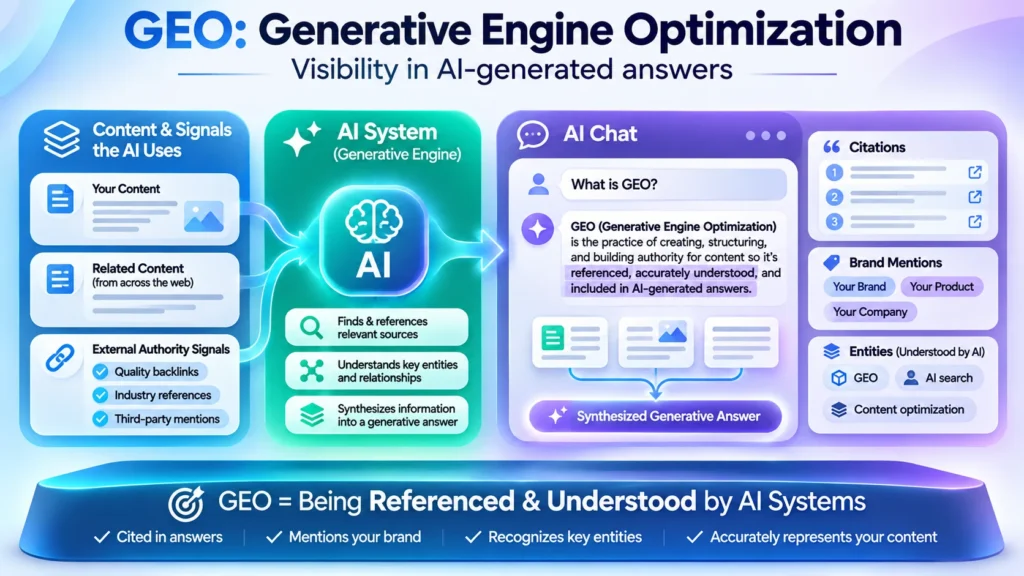
Generative Engine Optimization (GEO) is the practice of improving a brand’s and website’s visibility within AI-generated responses.
Unlike traditional search engines, which commonly display ranked links, generative AI platforms can combine information from different sources to create a conversational answer.
Examples of relevant platforms include:
- ChatGPT
- Claude
- Perplexity
- Google AI Overviews and AI Mode
- Other generative AI-powered search experiences
Imagine someone asks ChatGPT:
“Which companies provide reliable commercial cleaning services in Singapore?”
The AI platform may generate a list of businesses, explain their services, compare relevant features, and provide links to supporting sources.
For a business, appearing in those responses can create an additional discovery opportunity.
However, there is an important distinction between being mentioned and being cited.
A brand mention means the AI platform names a business. A citation means the platform identifies a source supporting information in its response. A website can receive a citation without necessarily receiving a prominent brand recommendation.
GEO aims to improve the likelihood that a business’s information, expertise, and relevant web pages are discovered, understood, and considered by generative AI systems.
What Makes a Website GEO-Friendly?
1. Build genuine topical authority
A website should demonstrate meaningful knowledge of the subjects connected to its products, services, or industry.
For example, a company offering pest control should publish useful information about pest identification, prevention, treatment options, safety considerations, and relevant service solutions.
Publishing dozens of unrelated articles simply to increase website size does not create meaningful authority.
2. Develop a recognizable brand identity
AI systems need to understand which organization a website represents, what it offers, where it operates, and what makes it relevant.
Consistent business information, detailed About pages, service descriptions, and credible external references help establish this context.
3. Publish original and verifiable information
Generic articles often repeat information already available across hundreds of websites.
Businesses can stand out by publishing original research, expert explanations, first-hand observations, genuine case studies, practical comparisons, and clearly attributed information.
4. Strengthen external credibility
Your website is not the only place where your brand’s reputation is established.
Relevant industry publications, professional directories, authoritative websites, independent reviews, and credible third-party references can contribute to how people and AI systems understand a business.
5. Make important information accessible
Your website content should be publicly accessible where appropriate, crawlable, indexable, and clearly organized.
A valuable article that cannot be discovered or accessed has limited opportunities to contribute to search visibility.
GEO is therefore not simply about inserting AI-related keywords into content. It is about becoming a relevant, understandable, and credible source of information.
SEO vs AEO vs GEO: Understanding the Key Differences
SEO, AEO, and GEO share many underlying principles, but they emphasize different discovery experiences.
| Area | SEO | AEO | GEO |
|---|---|---|---|
| Primary focus | Search visibility | Direct answers | AI-generated visibility |
| Main objective | Improve organic discoverability | Provide answer-ready information | Improve AI mentions and citations |
| Typical platforms | Google, Bing | Featured snippets, answer experiences | ChatGPT, Claude, Perplexity |
| Content approach | Relevant, comprehensive content | Clear, direct answers | Context-rich, credible information |
| Important signals | Relevance, technical accessibility, quality, authority | Answer clarity, relevance, structure | Retrieval, relevance, source credibility, brand recognition |
| Desired outcome | Organic visibility and qualified visits | Visibility within answers | Brand mentions, citations and discovery |
These are differences in emphasis, not completely independent sets of ranking rules.
A well-written service page can support all three approaches simultaneously.
For example, a detailed article about commercial cleaning services can:
- Rank organically for relevant commercial cleaning keywords through SEO.
- Answer questions about service frequency, pricing, and cleaning methods through AEO.
- Provide relevant, verifiable information that may be retrieved or cited by AI platforms through GEO.
The same content serves different discovery experiences.
That is why businesses should avoid treating SEO, AEO, and GEO as three isolated marketing projects.
How SEO, AEO, and GEO Complement Each Other
The relationship becomes clearer when we look at how people discover information.
Imagine a business owner searching for a reliable commercial cleaning company.
First, they might search Google for “commercial cleaning services Singapore.”
They discover a company through its organic search listing. This is where SEO contributes.
Next, they want to understand whether the company provides office cleaning, industrial cleaning, or customized cleaning schedules. They find direct answers within the company’s service pages. This is where AEO contributes.
Finally, they ask an AI platform to recommend commercial cleaning providers based on specific requirements. The platform may consider relevant information from websites and other available sources. This is where GEO becomes relevant.
The discovery journey can therefore involve all three approaches.
1. SEO Helps Search Engines Discover and Understand Your Website
Without accessible pages, relevant content, and a clear website structure, important information may be difficult for search engines to discover.
Technical SEO, content optimization, internal linking, and authority building help establish the foundation.
2. AEO Makes Your Information Easier to Use as an Answer
Once your content is discoverable, organizing it around real questions makes it more useful for people looking for specific information.
Clear explanations, descriptive headings, and well-supported answers improve content usability.
3. GEO Extends Your Visibility into AI-Generated Experiences
Generative AI platforms may retrieve and synthesize information from multiple sources.
Relevant content, recognizable entities, credible external references, and accessible information can support your opportunities to appear in these experiences.
The important point is that these activities reinforce one another.
A technically sound website with useful information and a credible brand has a stronger foundation than a website relying entirely on keyword placement or isolated AI optimization tricks.
Why Good SEO Is the Foundation of AEO and GEO
This is the most important part of the discussion.
There is a growing tendency to market AEO and GEO as entirely new disciplines that require businesses to abandon traditional SEO.
But the relationship is more connected than that.
Google’s official guidance makes this particularly clear. Its documentation explains that existing SEO best practices remain relevant for AI Overviews and AI Mode. Pages must meet the relevant Search eligibility requirements, and there are no additional special technical requirements for appearing in these Google AI features.
Google also explains that its generative search experiences use information retrieved through its core Search systems.
This does not mean that ranking in Google guarantees a citation in ChatGPT or Claude. Each platform has its own retrieval processes, models, sources, and selection mechanisms.
It does demonstrate why strong SEO foundations continue to matter.
Let’s look at the relationship through six important areas.
1. Technical SEO Supports Content Accessibility
Think about a website with excellent information but blocked crawling, broken navigation, poor rendering, or important content hidden behind inaccessible functionality.
Even the best-written article has limited discovery opportunities if relevant systems cannot access it.
Technical SEO helps address these problems through:
- Crawlability and indexability.
- Proper robots.txt configuration.
- XML sitemaps.
- Logical URL structures.
- Mobile-friendly design.
- Appropriate canonical tags.
- Fast and reliable page delivery.
- Accessible text-based content.
These improvements support traditional search visibility and can also help make information accessible to AI-powered retrieval systems.
2. Search Intent Optimization Improves Answer Relevance
Good SEO begins with understanding what people actually want.
Someone searching for “SEO services” may be comparing agencies, looking for pricing, or trying to understand what an SEO campaign includes.
Someone asking “How long does SEO take to show results?” has a different information need.
When content is developed around these underlying questions, it becomes more useful across different search experiences.
AEO builds on this foundation by making answers clear and direct.
GEO benefits when content meaningfully addresses the questions that generative systems are trying to answer.
3. Topical Authority Strengthens Subject Understanding
Imagine two websites.
Website A publishes 50 unrelated articles across different industries.
Website B focuses on digital marketing and consistently publishes useful information about SEO, technical optimization, content strategy, local search, analytics, and AI search visibility.
Website B has a clearer topical focus.
That does not automatically mean it will rank higher, but a well-developed collection of related content can help search engines and readers understand the website’s subject expertise.
A connected content strategy also gives AI systems more relevant information to retrieve when responding to related questions.
4. Quality Content Creates Opportunities for AI Citations
AI platforms need information that is relevant to the question being asked.
A generic article that repeats common definitions may provide little additional value.
Consider an article about SEO pricing.
Instead of simply stating that SEO costs vary, a more useful article could explain:
- Which activities are included in an SEO campaign.
- Why technical SEO and content costs differ.
- How competition influences campaign requirements.
- What businesses should expect from monthly reporting.
- Which performance indicators should be monitored.
When these explanations are accurate, specific, and supported by credible evidence, they offer more useful information to both readers and systems retrieving web content.
5. Brand Authority Extends Beyond Your Website
A business can publish excellent content and still have limited brand recognition.
Consider a customer researching two marketing agencies.
One agency has a detailed website, consistent business information, genuine customer reviews, relevant industry mentions, and independently published case studies.
The other has only a basic website with several promotional articles.
The first agency provides more external context for people evaluating its credibility.
This matters in GEO because AI visibility is not determined by a website’s own content alone.
Third-party references, brand reputation, and the relevance of external sources can all influence discovery and recommendations.
6. Internal Linking Connects Your Expertise
Internal links help people and search engines discover relationships between different pages on your website.
For example, an article about technical SEO can link to related content about:
- Website crawlability.
- Indexing issues.
- Core Web Vitals.
- XML sitemaps.
- Website architecture.
These links create a more connected content experience.
They also help establish context around your important topics and direct users toward relevant information.
The takeaway is simple: strong SEO does not guarantee AI visibility, but it creates many of the conditions that make broader search visibility possible.
How to Build One Strategy for SEO, AEO, and GEO
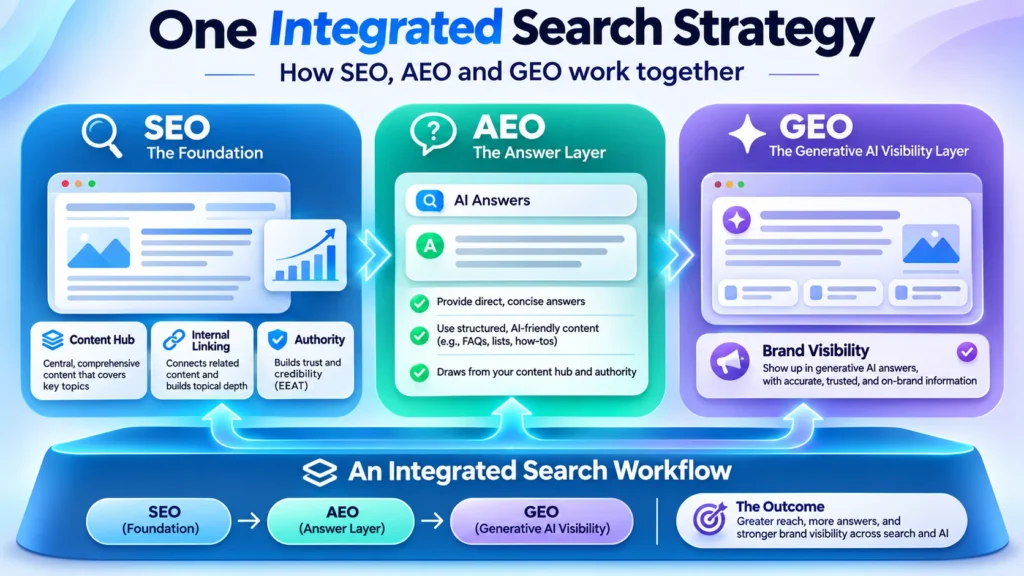
Instead of developing three separate strategies, businesses should build one integrated optimization process.
Here is a practical framework.
Step 1: Start With Keyword and Search Intent Research
Identify the main topics your target audience searches for.
Then expand those topics into related questions, comparisons, problems, and decision-making queries.
For example, a digital marketing agency could organize its content around:
Core topic: SEO services
Related keyword cluster:
- SEO services.
- SEO agency.
- SEO consultant.
- SEO pricing.
- Local SEO services.
- Technical SEO services.
Question-based cluster:
- What do SEO services include?
- How much do SEO services cost?
- How long does SEO take?
- Is SEO worth it for small businesses?
- How do I choose an SEO agency?
Comparison cluster:
- SEO vs PPC.
- SEO vs AEO.
- SEO vs GEO.
- Local SEO vs national SEO.
This approach provides content opportunities for organic search, answer-focused experiences, and generative AI discovery.
Step 2: Build Topic Clusters and Content Hubs
Avoid publishing isolated articles without a clear relationship.
Instead, create a central pillar page around an important topic and connect supporting articles to it.
For example:
Pillar Page: Complete Guide to Search Engine Optimization
Supporting articles:
- Technical SEO Explained.
- On-Page SEO Best Practices.
- Keyword Research Guide.
- Internal Linking Strategy.
- Local SEO Guide.
- SEO vs AEO vs GEO.
- How AI Search Is Changing SEO.
Each supporting article should address a specific search intent while contributing to the broader topic.
Use natural, descriptive internal links rather than forcing exact-match keywords into every anchor.
Step 3: Write for People First, Then Structure for Discovery
Every important page should answer its primary question clearly.
A useful structure includes:
- A clear introduction explaining the problem.
- A direct answer to the main question.
- Detailed explanations under descriptive headings.
- Relevant examples and practical scenarios.
- Supporting statistics or authoritative references where available.
- A useful conclusion and next step.
This makes the content easier to read, navigate, and interpret.
Do not confuse answer-friendly content with extremely short content. Complex questions often require detailed explanations.
Step 4: Strengthen Entity and Brand Understanding
Make it clear who publishes the content and what the organization does.
Important elements include:
- A complete About page.
- Accurate business contact information.
- Clear author biographies and relevant expertise.
- Consistent brand descriptions.
- Detailed product and service pages.
- Relevant Organization, Person, and other appropriate structured data.
- Genuine external references and brand mentions.
Structured data should accurately represent visible page information. It can help describe entities, but it does not guarantee AI citations or search rankings.
Step 5: Build External Authority
Develop a reputation beyond your own website.
Practical activities include:
- Contributing expert articles to relevant publications.
- Earning links from credible industry websites.
- Publishing original research and useful industry insights.
- Encouraging genuine customer reviews.
- Participating in relevant professional discussions.
- Maintaining accurate business profiles and directory listings.
Focus on relevance and credibility rather than accumulating large numbers of low-quality backlinks or artificial brand mentions.
Step 6: Measure More Than Traditional Rankings
Traditional keyword rankings remain important, but they are no longer the only useful measurement.
Track:
SEO Performance
- Organic clicks and impressions.
- Keyword rankings.
- Indexed pages.
- Organic conversions.
- Qualified organic traffic.
AEO Performance
- Relevant answer-feature appearances where measurable.
- Visibility for question-based queries.
- Featured snippet performance where applicable.
- Accuracy and usefulness of answers across target queries.
GEO Performance
- Brand mentions in AI-generated responses.
- Website citations and linked sources.
- Share of voice across relevant AI prompts.
- Referral traffic from AI platforms.
- Quality of the recommendations and context in which your brand appears.
Test multiple relevant questions across platforms and repeat them periodically. AI responses can vary by prompt, location, platform, and time.
The goal is to understand whether your brand is becoming more discoverable and trusted across different search experiences.
How to Improve Visibility in Google, ChatGPT, Claude, and Perplexity
Each platform has its own approach to discovering and presenting information. There is no universal formula that guarantees visibility everywhere.
However, several practical principles can help businesses prepare.
Google Search and AI Overviews
Start with the fundamentals of Google Search:
- Make important pages crawlable and indexable.
- Publish original, helpful, people-first content.
- Use descriptive page titles and headings.
- Maintain a logical internal linking structure.
- Keep structured data consistent with visible content.
- Provide useful images and videos where relevant.
- Maintain accurate Google Business Profile information where applicable.
Monitor organic search performance through Google Search Console.
Google’s guidance specifically emphasizes that strong SEO practices remain relevant to its generative AI search experiences.
ChatGPT
ChatGPT can use web search to retrieve current information and provide links to supporting sources.
Businesses that want to be discoverable through ChatGPT should consider:
- Making relevant public website content accessible.
- Reviewing crawler access and website infrastructure.
- Publishing clear, useful, accurate information.
- Building recognizable brand authority.
- Monitoring brand mentions and website citations.
Website owners can review OpenAI’s published crawler documentation to understand the distinction between OAI-SearchBot, which is associated with search, and GPTBot, which is associated with model training.
Allowing a crawler does not guarantee that a website will be selected or cited.
Claude
Claude can also use web search in supported experiences.
For businesses, the same broader principles apply:
- Maintain accessible website content.
- Publish accurate and well-supported information.
- Establish clear brand and author identities.
- Build credible external recognition.
- Monitor whether relevant pages and brand information appear in AI-generated answers.
Check Anthropic’s official crawler documentation and website policies before making technical access decisions.
Perplexity
Perplexity provides search-oriented answers with supporting citations.
For businesses seeking visibility, useful considerations include:
- Publishing detailed, source-supported information.
- Making important content easy to retrieve.
- Addressing specific user questions.
- Keeping factual information current.
- Establishing credible external references.
Do not focus exclusively on one AI platform. The more sustainable approach is to build a website and brand that provide reliable information across the broader search ecosystem.
The Future of Search Is Integrated Optimization
The future of search is unlikely to be defined by a choice between SEO, AEO, and GEO.
People will continue using traditional search engines, direct-answer experiences, AI assistants, and other discovery platforms depending on what they need.
Some users will want a list of websites. Others will want a direct answer. Some will ask an AI assistant to research, compare, and recommend options.
Businesses need to be prepared for all these experiences.
That does not mean creating three different versions of every page or following a new optimization trick for every AI platform.
It means building a website that is technically accessible, publishing content that genuinely helps people, establishing a recognizable brand, and developing authority through trustworthy information and real-world credibility.
A business with strong SEO foundations has a meaningful starting advantage because many of the principles behind SEO also support answer discovery and generative search visibility.
AEO helps make the information easier to use as an answer. GEO extends the focus toward how that information and brand may appear in AI-generated experiences.
SEO builds the foundation. AEO makes your expertise easier to extract. GEO extends your visibility into generative AI.
Ultimately, the strongest strategy is not SEO versus AEO versus GEO.
It is good SEO, supported by answer-focused content and a credible brand, working together across the entire search ecosystem.
Frequently Asked Questions (FAQs)
1. What is the difference between SEO, AEO, and GEO?
SEO focuses on improving visibility in traditional search engine results. AEO focuses on making information useful and accessible for direct-answer experiences. GEO focuses on improving brand and content visibility within generative AI responses. All three share important foundations, including content quality, relevance, accessibility, and credibility.
2. Is SEO still important for AI search?
Yes. SEO remains important because search engines and AI-powered search experiences still rely on discovering, understanding, and retrieving relevant information. Google explicitly confirms that its established SEO best practices remain relevant for AI Overviews and AI Mode.
3. Does good SEO automatically improve GEO?
Good SEO can support GEO by improving website accessibility, content relevance, topical coverage, and discoverability. However, strong Google rankings do not guarantee that ChatGPT, Claude, or Perplexity will mention or cite a website. Each platform has its own retrieval and selection processes.
4. How does SEO help AEO?
SEO helps establish relevant, accessible, well-organized content. AEO builds on that foundation by presenting useful information in a clear structure, answering specific questions, and providing appropriate context.
5. Does GEO replace traditional SEO?
No. GEO does not make traditional SEO unnecessary. It expands the scope of search visibility to include generative AI experiences. Businesses should continue investing in technical SEO, useful content, authority, and user experience while monitoring their AI search visibility.
6. How can I get my website cited by ChatGPT?
Start by publishing relevant, accurate, and useful content that addresses real questions. Ensure your important pages are publicly accessible and technically discoverable. Build brand authority through credible external references and monitor relevant prompts to understand whether ChatGPT cites your website. No method guarantees a citation.
7. What is more important: AEO or GEO?
Neither is universally more important. AEO emphasizes answer-oriented information, while GEO focuses on generative AI visibility. The right priorities depend on your audience, industry, search behavior, and business objectives. Both benefit from strong SEO foundations.
8. Do I need separate SEO, AEO, and GEO strategies?
Not necessarily. A unified search visibility strategy is generally more practical. It should combine technical SEO, search intent research, useful content, clear answers, topical authority, brand credibility, and AI visibility monitoring.
9. Does FAQ schema help with AEO and GEO?
FAQ schema can describe qualifying question-and-answer content, but it does not guarantee rankings, featured answers, or AI citations. Google has also deprecated its FAQ rich result display. Focus on providing genuinely useful FAQ content and use structured data only when appropriate and compliant with current guidelines.
10. How long does it take to see results from SEO, AEO, and GEO?
There is no universal timeline. Results depend on website history, technical condition, competition, content quality, industry authority, and how frequently platforms retrieve relevant information. Monitor progress consistently rather than expecting immediate rankings or AI citations.
Final Thoughts
Search is evolving, but the importance of useful information, technical accessibility, and genuine credibility has not disappeared.
Businesses do not need to abandon SEO to prepare for AI-powered search. They need to strengthen the foundations of SEO and apply those principles to the way people now discover and consume information.
If your website is easy to discover, your content genuinely answers questions, and your brand earns trust beyond its own website, you are building a stronger foundation for traditional search, answer engines, and generative AI.
Good SEO is good AEO. Good SEO is good GEO. And the future belongs to businesses that understand how to make all three work together.