The Future of SEO: How AI Search Is Changing Business
The future of SEO is not simply about ranking higher on Google anymore. Search is evolving as artificial intelligence changes how people discover information, compare businesses, evaluate products, and make purchasing decisions.
Think about how people used to search for a service. They would type a keyword into Google, open several websites, compare prices, read reviews, and decide which business to contact.
Today, that journey is becoming more conversational.
Someone might ask ChatGPT to recommend a suitable service provider, use Perplexity to compare different solutions, or explore Google’s AI-powered search features to understand a complicated topic before visiting a website.
This change is creating new opportunities and challenges for businesses, marketers, website owners, and SEO professionals.
But does this mean traditional SEO is becoming irrelevant? Not at all.
What is changing is the way people discover information and interact with search results. Businesses now need to think beyond keyword rankings and focus on broader search visibility, brand authority, useful content, and customer experience. Understanding how SEO, AEO, and GEO work together can help businesses build a more effective strategy for the evolving search landscape.
In this guide, we’ll explore how AI is changing search behavior, why traditional SEO still matters, how customer buying decisions are evolving, and what businesses should do to prepare for the next generation of search.
How Search Behavior Is Changing in the AI Era
Search behavior has changed significantly over the years.
In the early days of search engines, people often used short keywords such as “best laptop,” “SEO agency,” or “plumber near me.”
Modern users increasingly use longer, more specific, and conversational queries.
Instead of searching for:
“Best CRM software”
A business owner might ask:
“Which CRM software is suitable for a small business with five employees that needs WhatsApp integration and affordable monthly pricing?”
The second query communicates much more about the user’s actual needs.
AI-powered search experiences make this type of interaction easier by allowing users to ask follow-up questions, explore comparisons, and refine their requirements without starting a completely new search each time.
From Keyword-Based Search to Conversational Search
Traditional keyword searches are still important, but people are becoming more comfortable expressing their needs in natural language.
Consider these examples:
| Traditional Search | AI-Powered Search Query |
|---|---|
| Best SEO agency | Which SEO agency is suitable for a small business with a limited budget? |
| AC repair Singapore | How do I know whether my air conditioner needs repair or replacement? |
| Best CRM software | Compare affordable CRM tools with WhatsApp integration for small businesses. |
| Commercial cleaning | What should I consider before hiring a commercial cleaning company? |
Notice the difference.
The user is no longer simply looking for a webpage containing a particular keyword. They want an explanation, recommendation, comparison, or solution.
For businesses, this means content needs to address the complete information need rather than targeting isolated search phrases.
Search Is Becoming More Contextual
Modern search experiences increasingly support follow-up questions and more detailed interactions.
For example, someone might ask:
- What is local SEO?
- How does local SEO help a small business?
- How much does local SEO cost?
- How can I choose a local SEO agency?
Each question builds on the previous one.
A website that provides useful, connected information across these topics can become a more valuable resource throughout the research process.
This is why understanding search intent and building relevant topic clusters remain important parts of modern SEO.
Traditional Search vs AI-Powered Search
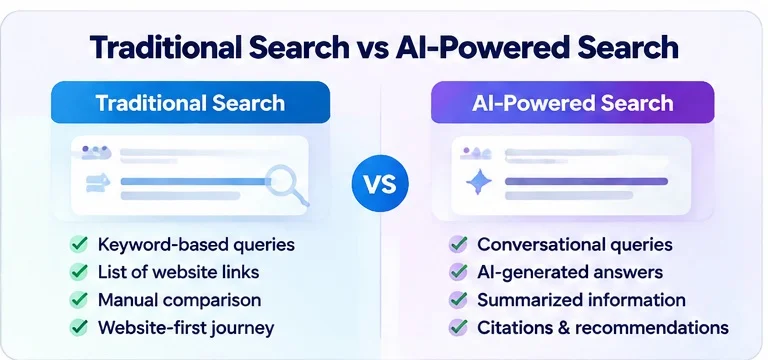
Traditional search engines and AI-powered search platforms serve a similar fundamental purpose: helping people find useful information.
However, the way they present information can be different.
Traditional search commonly presents a list of relevant webpages. Users explore those pages and evaluate the information themselves.
AI-powered search experiences can retrieve information from multiple sources, summarize relevant findings, and present a conversational response with supporting links or citations.
Key Differences Between Traditional and AI Search
| Comparison | Traditional Search | AI-Powered Search |
|---|---|---|
| Search method | Keywords and phrases | Keywords and conversational questions |
| Results | Ranked webpages | Generated answers with relevant sources |
| User experience | Browse and compare links | Ask, explore, and refine questions |
| Information | Individual webpages | Synthesized information from sources |
| Discovery | Organic listings and other SERP features | AI answers, mentions, and citations |
| User journey | Often website-first | May involve answers before website visits |
These differences do not mean that traditional search is disappearing.
Google remains an important search destination, while AI-powered experiences are creating additional ways to discover information.
For website owners, the opportunity is to build visibility across both environments.
The Growing Role of AI Search Platforms
Several platforms are influencing the modern search experience.
Google AI Overviews and AI Mode
Google’s AI-powered search experiences help users explore complicated questions and discover relevant webpages. Supporting links provide opportunities for websites to attract attention beyond traditional blue-link listings.
ChatGPT can use web search to retrieve current information and provide linked sources in supported search experiences. This creates additional opportunities for relevant websites to be discovered.
Claude
Claude also supports web search in applicable experiences, allowing users to explore current information and review supporting sources.
Perplexity
Perplexity provides search-oriented answers with citations, helping users investigate topics through conversational queries.
The important lesson is that businesses should not depend entirely on one search platform. A broader search visibility strategy is more resilient.
Why Google Rankings Are No Longer the Only Visibility Metric
For many years, SEO performance was largely evaluated through keyword positions, organic clicks, impressions, and website traffic.
These metrics still matter. However, they do not tell the complete story of how people discover a brand.
Imagine two businesses competing in the same industry.
Business A ranks well for several keywords and receives organic traffic.
Business B also ranks organically but is additionally mentioned in relevant AI-generated answers, referenced by industry publications, and recognized through credible third-party sources.
Business B may have more opportunities to reach customers across different discovery channels.
This does not mean AI mentions automatically produce more revenue. The value depends on relevance, audience quality, brand perception, and whether those interactions lead to meaningful business outcomes.
Search Visibility Is Bigger Than Keyword Rankings
Modern SEO professionals should consider several performance indicators:
- Organic keyword rankings.
- Search impressions and clicks.
- Brand searches.
- Organic conversions.
- AI-generated brand mentions.
- Website citations in AI answers.
- Referral traffic from AI platforms.
- Qualified leads from different discovery channels.
For example, a business might notice that its organic traffic remains relatively stable while its brand begins appearing more frequently in AI-generated answers.
Traditional ranking reports alone would not capture that entire change.
This is why businesses should gradually expand their SEO reporting to include broader search visibility.
Why Brand Visibility Matters
People do not always visit a website immediately after discovering a business.
They may first encounter the brand through a Google result, read a third-party review, see a recommendation in an AI answer, or hear about it through an industry publication.
By the time they visit the website, they may already have an impression of the company.
Strong brand visibility helps create familiarity and provides more opportunities for customers to recognize and evaluate a business.
For this reason, SEO should not focus exclusively on attracting clicks. It should also help businesses become recognizable and credible within their relevant markets.
The Rise of Zero-Click Searches
One of the important changes in modern search is the growth of zero-click experiences.
A zero-click search happens when someone obtains the information they need directly from a search results page without clicking through to an external website.
For example, someone searching for the weather, a simple definition, or a quick factual answer may find the information directly in the search interface.
AI-generated summaries can extend this behavior by answering more complex questions directly within search experiences.
Why Zero-Click Searches Matter for Businesses
Consider someone searching:
“What is technical SEO?”
They may receive a direct explanation without needing to visit a website.
However, someone searching:
“Which technical SEO problems are preventing my ecommerce website from getting organic traffic?”
may still need detailed analysis, professional advice, tools, or a service provider.
This distinction matters.
Simple informational searches may be satisfied directly, while more complex research and commercial searches can still create opportunities for website visits and conversions.
How to Adapt Your SEO Strategy for Zero-Click Searches
Instead of focusing only on clicks, businesses should consider the full value of search exposure.
Practical steps include:
- Build brand recognition around important topics.
- Publish useful information that demonstrates expertise.
- Answer customer questions clearly.
- Create detailed resources that provide value beyond a short summary.
- Strengthen commercial and service pages.
- Monitor impressions, qualified traffic, and conversions together.
An important point: zero-click behavior is not uniform across every industry or query.
The impact depends on search intent, the type of question, the search platform, and the information displayed.
Businesses should analyze their own performance rather than assuming every AI-powered search feature reduces traffic.
How AI Is Changing Customer Buying Decisions
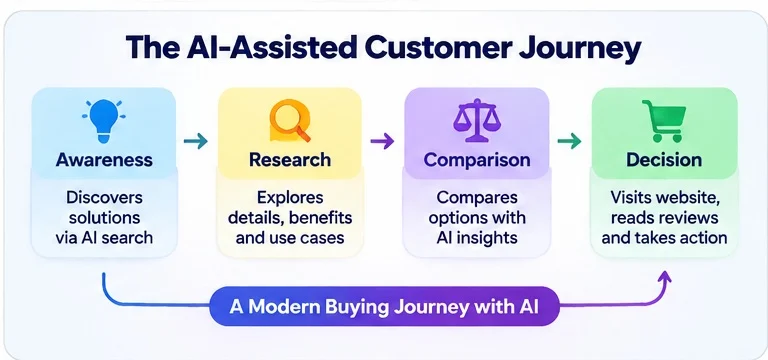
One of the biggest changes in the future of SEO is how AI-powered tools influence the customer journey.
Previously, customers often visited several websites before comparing products or services.
Now, they can use AI assistants to summarize options, identify important differences, and prepare questions before contacting a business.
This changes how companies need to communicate their value.
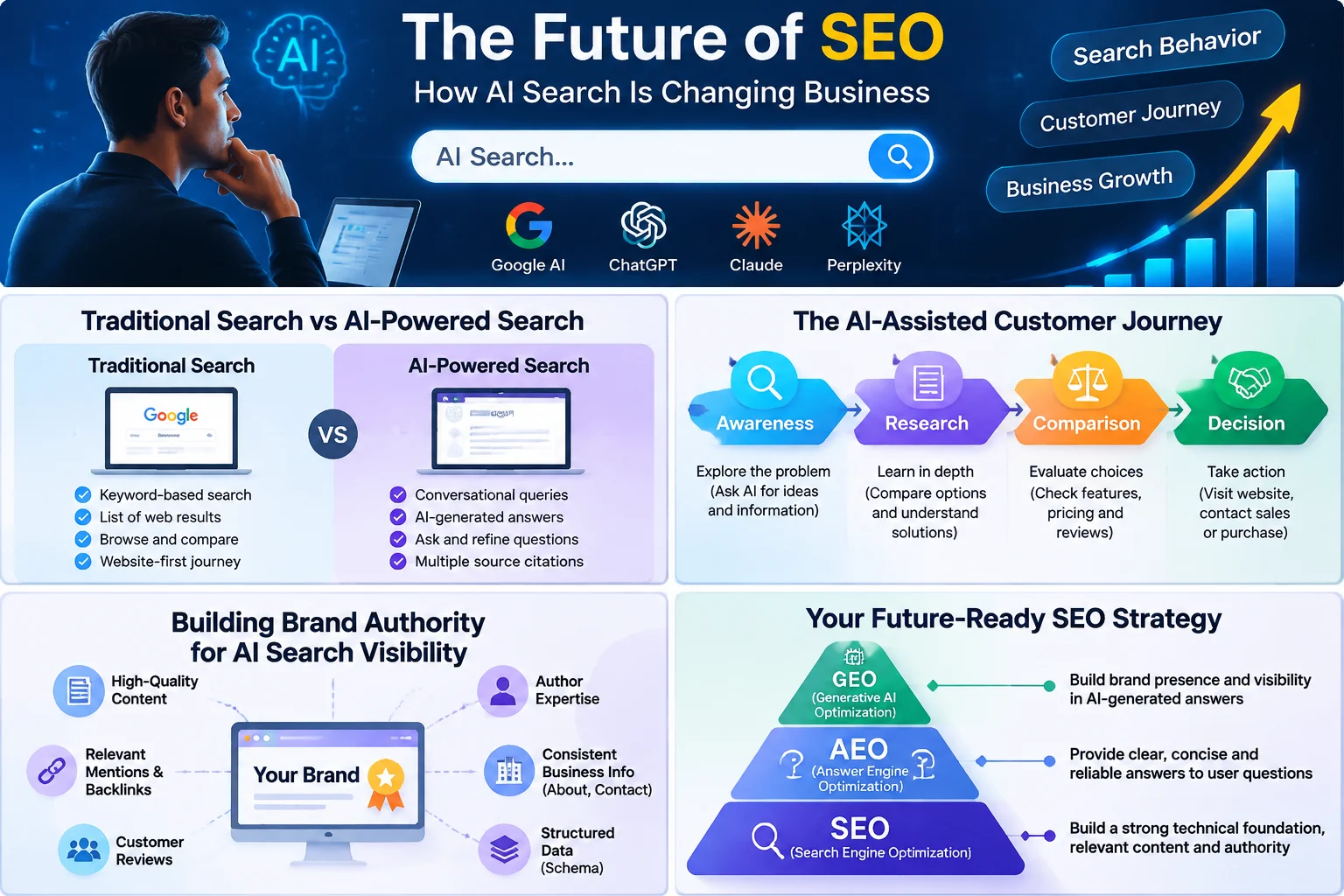
The New AI-Assisted Customer Journey
Consider someone planning to hire an SEO agency.
Their journey might look like this:
Stage 1: Awareness
The customer asks an AI assistant:
“What digital marketing strategies can help a small business attract more customers?”
The AI explains SEO, paid advertising, content marketing, and social media.
Stage 2: Research
The customer asks:
“How does local SEO help a small business generate leads?”
They explore relevant explanations and supporting sources.
Stage 3: Comparison
The customer asks:
“What should I look for when choosing an SEO agency?”
They learn about technical audits, content strategy, reporting, experience, and pricing.
Stage 4: Decision
The customer visits relevant agency websites, reviews case studies, checks services, and requests a consultation.
This is an illustrative customer journey, but it reflects an important strategic opportunity: businesses need useful content for every stage of the buying process.
Why Businesses Need More Than Promotional Content
A website filled with promotional statements such as “We are the best agency” or “We provide world-class services” does not necessarily help customers make decisions.
People need specific information.
For example, an SEO agency should explain:
- What its SEO services include.
- How technical SEO audits work.
- What happens during the first 90 days.
- How keyword research influences content strategy.
- Which performance indicators are monitored.
- What factors influence campaign pricing.
- What clients should realistically expect.
Detailed and transparent information helps customers evaluate the business more confidently.
It also gives search systems more useful context about the company’s expertise and services.
Why Brand Authority Matters More Than Ever
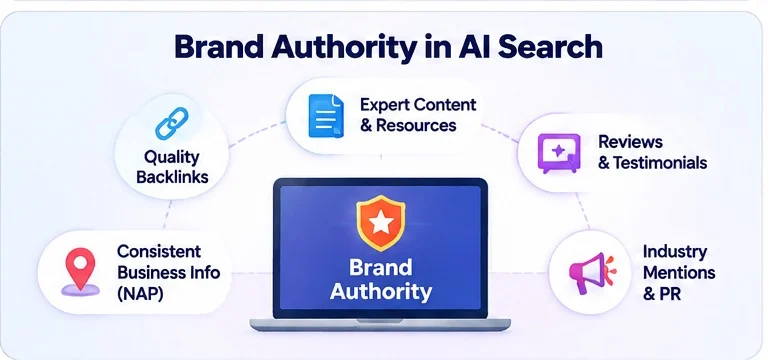
As search becomes more conversational, brand recognition and credibility become increasingly important.
When someone asks an AI assistant to recommend a business, the answer may depend on the information the platform can retrieve and evaluate.
That information may come from the business website, independent publications, directories, reviews, and other publicly accessible sources.
This is why brand authority should not be treated as something that exists only on your website.
Build a Recognizable Brand Identity
Start by making your business information consistent and understandable.
Important website elements include:
- A detailed About Us page.
- Clear descriptions of products and services.
- Accurate business contact information.
- Relevant author profiles.
- Genuine customer testimonials.
- Appropriate Organization and LocalBusiness structured data.
- Consistent business information across relevant platforms.
Structured data helps describe information on a page, but it cannot manufacture credibility or guarantee AI recommendations.
Earn Relevant Third-Party Recognition
Businesses should also develop their reputation beyond their own websites.
Practical activities include:
- Contributing expert insights to relevant industry publications.
- Earning editorial backlinks.
- Publishing original research.
- Participating in relevant professional communities.
- Encouraging genuine customer reviews.
- Building partnerships with credible organizations.
Focus on quality and relevance rather than collecting artificial mentions or low-quality backlinks.
Demonstrate Real Experience
Imagine two articles explaining the importance of local SEO.
The first repeats general definitions and standard optimization tips.
The second explains how a local business can improve its Google Business Profile, organize service-area pages, handle customer reviews, and measure qualified leads.
The second article provides more practical value because it explains how the strategy works in a real business context.
Original observations, genuine examples, documented results, and transparent methodology can make your content more distinctive.
Do not invent client results or publish fictional case studies. Real evidence is more valuable than exaggerated claims.
How Businesses Should Adapt Their SEO Strategy
The future of SEO does not require businesses to abandon everything they have already built.
Instead, they should strengthen existing SEO foundations and extend their strategy to cover modern search experiences.
Here is a practical framework.
1. Strengthen Technical SEO
Technical SEO remains essential.
Make sure important pages can be discovered, crawled, rendered, and indexed.
Review:
- Robots.txt configuration.
- XML sitemaps.
- Canonical tags.
- Internal linking.
- Mobile usability.
- Page performance.
- HTTPS security.
- JavaScript rendering.
- Structured data accuracy.
A website should also present its most important information in accessible text rather than relying entirely on images or inaccessible interactive elements.
2. Focus on Search Intent and Keyword Clustering
Do not build your entire strategy around a single keyword.
Create keyword clusters based on the questions and decisions your target customers make.
For example, a business offering digital marketing services might organize its content like this:
Core Topic: SEO Services
Supporting clusters:
- Technical SEO.
- On-page SEO.
- Local SEO.
- Keyword research.
- Content optimization.
- SEO pricing.
- SEO reporting.
AI Search supporting cluster:
- Future of SEO.
- AI Search Optimization.
- SEO vs AEO vs GEO.
- AI Search Visibility.
- Zero-Click Searches.
This approach helps create a connected content ecosystem rather than a collection of unrelated blog posts.
3. Create Helpful, Original Content
Content should answer real questions and provide information that is useful even when someone reads it without visiting another page.
Include:
- Clear explanations.
- Relevant examples.
- Practical recommendations.
- Original observations.
- Accurate supporting references.
- Updated information.
- Transparent authorship.
Avoid publishing large volumes of generic AI-generated articles that repeat the same information without adding meaningful value.
AI can assist with research, outlining, and editing, but the final content should be reviewed for accuracy, originality, and usefulness.
4. Build Topic Clusters and Internal Links
A strong internal linking strategy helps connect related information across your website.
For example, your main SEO guide can link to supporting articles about technical SEO, keyword research, on-page optimization, local SEO, and AI search.
Each supporting article should also link naturally to relevant service pages and related educational resources.
This helps readers discover the next useful page and provides search engines with clearer information about your website structure.
5. Prepare Your Website for AI Search
Different AI platforms have different access and retrieval systems.
For example, OpenAI documents OAI-SearchBot for ChatGPT search discovery, while Anthropic distinguishes between ClaudeBot, Claude-SearchBot, and Claude-User for different purposes.
Businesses should review their robots.txt rules, hosting restrictions, CDN settings, and access policies.
Importantly, do not confuse AI training access with search visibility. Blocking a training crawler does not necessarily mean that search-related access must also be blocked.
Review the official documentation for OpenAI crawlers and Anthropic’s crawlers.
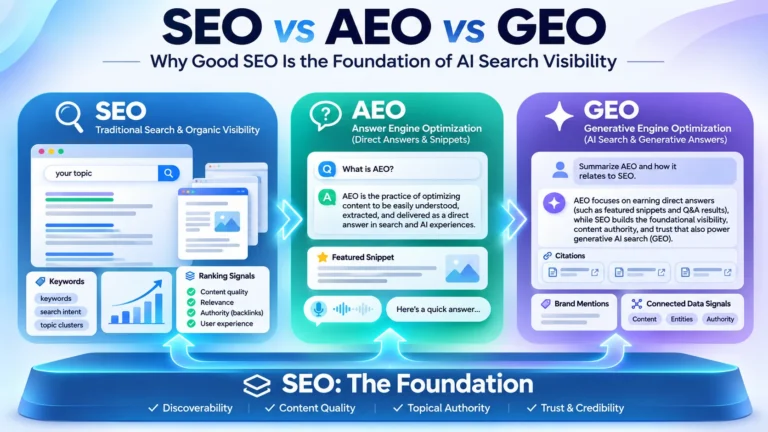
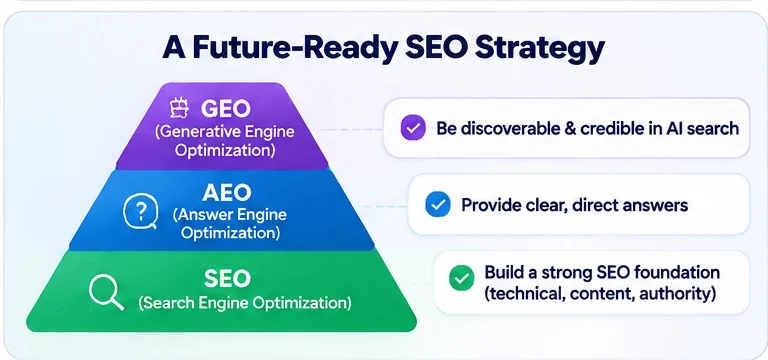
6. Integrate SEO, AEO, and GEO
A modern search strategy should combine three connected approaches.
SEO: Build discoverability through technical optimization, useful content, and authority.
AEO: Organize information so that it directly answers relevant customer questions.
GEO: Develop credible, accessible content and brand recognition that can support visibility in generative AI experiences.
These approaches are complementary. They should not become three disconnected projects with separate content calendars and conflicting priorities.
The Role of AI in Digital Marketing
AI is not only changing how people search. It is also changing how marketers plan, research, create, and measure campaigns.
Modern marketing teams can use AI to improve efficiency across several activities.
AI-Powered Keyword Research
AI tools can help marketers identify related search questions, understand topic relationships, group keywords, and develop content ideas.
However, keyword opportunities should still be validated using actual search data and business relevance.
Content Research and Development
AI can assist with content outlines, competitor research, summarization, and editing.
Human review remains important to ensure accuracy, originality, and useful insights.
Customer Intent Analysis
AI can help analyze customer questions, feedback, reviews, and common objections.
This can help businesses identify content gaps and understand what information potential customers need before making a decision.
Marketing Analytics
AI-assisted analytics can help marketers explore trends, identify unusual performance changes, and investigate possible opportunities.
But recommendations should always be checked against actual data.
The best use of AI is not to replace strategic thinking. It is to help marketing teams make better-informed decisions and work more efficiently.
How to Measure SEO Performance in the AI Search Era
If search behavior is changing, measurement needs to evolve as well.
Businesses should continue tracking traditional SEO metrics while adding relevant AI visibility indicators.
Traditional SEO Metrics
Monitor:
- Organic clicks.
- Search impressions.
- Click-through rate.
- Keyword positions.
- Indexed pages.
- Organic conversions.
- Revenue and qualified leads.
Google Search Console remains an important source for understanding organic search performance.
AI Search Visibility Metrics
Where measurable, also monitor:
- Brand mentions in AI-generated responses.
- Website citations and source links.
- Visibility across relevant AI prompts.
- AI referral traffic.
- Qualified leads from AI-referred sessions.
- Accuracy of brand and service descriptions in AI answers.
Test a consistent set of relevant prompts across ChatGPT, Claude, Perplexity, and Google AI experiences.
Record the date, platform, query, whether the brand appeared, which sources were cited, and the context of the recommendation.
AI responses can vary, so repeat testing and look for patterns rather than relying on a single result.
Use Google Search Console and Analytics Together
Google Search Console helps measure search impressions and clicks.
Google Analytics can help evaluate what happens after visitors reach the website.
Together, these tools help answer two important questions:
- Are people discovering your business?
- Are those visitors taking meaningful actions?
As of 2026, Google also provides dedicated reporting for generative AI search visibility through its Search Console reporting features. Check the available reports for your property and market.
The goal is to measure business outcomes, not simply collect more SEO metrics.
What Businesses Should Start Doing Today
Preparing for the future of SEO does not require a complete website redesign or an expensive collection of AI tools.
Start with a practical action plan.
| Timeline | Priority | Recommended Actions |
|---|---|---|
| Days 1–30 | Foundation | Technical SEO audit, keyword research, indexing review, content gap analysis |
| Days 31–60 | Content | Improve key service pages, build topic clusters, publish useful supporting articles |
| Days 61–90 | Authority | Strengthen internal linking, earn relevant mentions, improve brand information, review external references |
| Ongoing | Measurement | Track organic performance, conversions, AI visibility, and customer behavior |
For Small Businesses
Focus on the fundamentals first.
Build detailed service pages, maintain accurate business profiles, collect genuine reviews, and publish helpful information that answers common customer questions.
For Ecommerce Businesses
Make product information clear and consistent.
Provide accurate specifications, pricing, availability, delivery information, product comparisons, and genuine customer feedback.
For B2B Companies
Develop detailed educational resources that support complex purchasing decisions.
Publish industry insights, comparison guides, technical explanations, implementation resources, and genuine case studies.
Different industries need different priorities, but the underlying objective is the same: make your business easier to discover, understand, evaluate, and trust.
Frequently Asked Questions (FAQs)
1. What is the future of SEO?
The future of SEO involves a broader approach to search visibility. Traditional organic search remains important, while AI-powered search, conversational queries, generative answers, and brand discovery are creating additional opportunities for businesses.
2. Will AI replace traditional search engines?
AI is changing the search experience, but it is not simply replacing traditional search. People continue to use conventional search results, while AI-powered tools provide additional ways to discover and evaluate information.
3. Is traditional SEO still relevant in 2026?
Yes. Technical SEO, useful content, search intent, website accessibility, and authority remain important. Google also confirms that its established SEO best practices apply to AI Overviews and AI Mode.
4. How is AI changing SEO?
AI is influencing search behavior, content discovery, result presentation, and customer research. It is also helping marketers improve keyword research, content planning, and analytics. However, the fundamentals of useful and trustworthy content remain important.
5. What is AI Search Optimization?
AI Search Optimization refers to improving a website’s and brand’s visibility across AI-powered search experiences. It involves accessible content, relevant information, technical SEO, topical authority, and credible brand recognition.
6. How can businesses prepare for AI search?
Businesses should strengthen technical SEO, publish useful and original content, build topical authority, maintain consistent business information, and monitor visibility across relevant AI platforms.
7. What are zero-click searches?
Zero-click searches occur when users obtain the information they need directly from a search interface without clicking an external website. AI-generated summaries and other search features can contribute to this behavior.
8. How does AI affect organic website traffic?
The impact varies by industry, query, and search experience. Some informational searches may generate fewer website visits when answers are available directly in search results. However, websites can still attract valuable visitors through relevant citations, deeper resources, and commercial content.
9. How can my website appear in ChatGPT and Claude answers?
Publish accurate, relevant, and useful content, maintain technical accessibility, and develop credible brand recognition. Review each platform’s crawler policies and monitor relevant queries. There is no guaranteed method for earning an AI mention or citation.
10. Should businesses invest in SEO, AEO, and GEO separately?
Not necessarily. An integrated strategy is generally more efficient. SEO provides the foundation, AEO emphasizes clear and useful answers, and GEO extends the focus to generative AI discovery.
Final Thoughts: SEO Is Evolving, Not Disappearing
The way people search for information is changing, and businesses that ignore this shift may miss important opportunities.
But preparing for the future does not mean abandoning everything that made SEO valuable in the first place.
A technically accessible website, useful content, clear service information, relevant authority, and a strong customer experience remain important foundations.
What businesses need now is a broader understanding of visibility.
They should aim to appear where their customers search, provide answers when customers have questions, and build a brand that people can recognize and trust.
The future of SEO will not belong exclusively to businesses that use the most AI tools or publish the most content.
It will belong to businesses that understand their audience, provide genuinely useful information, and build lasting credibility across an increasingly connected search ecosystem.
Search is changing. Your SEO strategy should evolve with it.