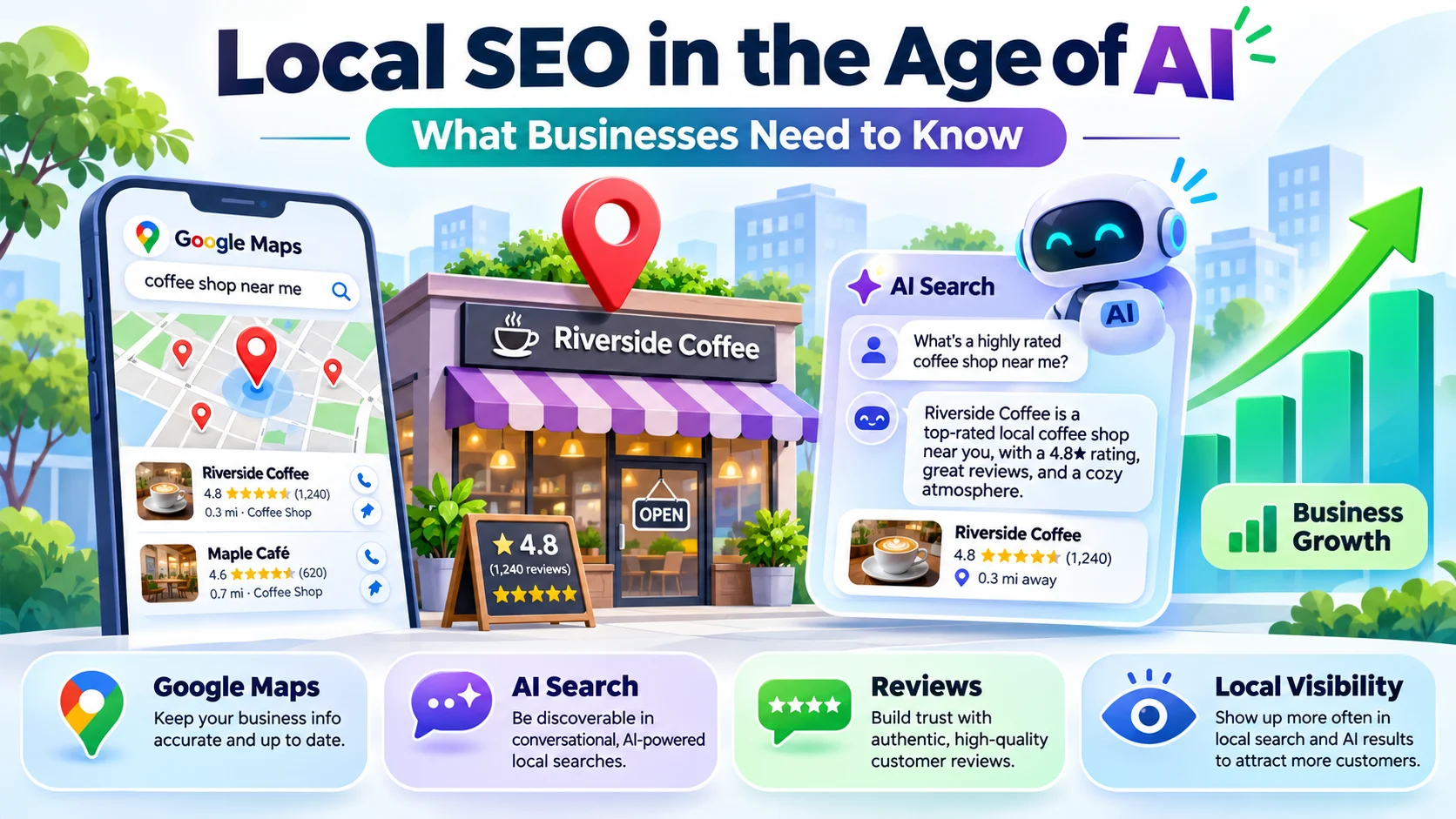
Local SEO in the Age of AI: What Businesses Need to Know
The way customers find local businesses is changing, and local SEO in the age of AI or AI in Local SEO is becoming increasingly important for companies that depend on local customers. People are no longer relying only on Google search results or Google Maps to find nearby services. They are also using AI-powered platforms such as ChatGPT, Claude, Perplexity, and Google’s AI search experiences to discover businesses, compare options, and make purchasing decisions.
Imagine someone searching for a reliable plumber in Singapore. Previously, they might have typed “plumber near me” into Google, checked a few business listings, read customer reviews, and contacted a provider.
Today, that person might ask an AI assistant, “Can you recommend a reliable plumber near my location who offers emergency repairs and transparent pricing?”
The search experience is different, but the customer’s objective remains the same: finding a trustworthy local business that can solve a specific problem.
For local businesses, this creates both an opportunity and a challenge. Ranking in traditional Google search results is still important, but businesses also need to think about how their information, services, reputation, and expertise appear across AI-powered discovery platforms.
The good news is that local SEO, Answer Engine Optimization (AEO), and Generative Engine Optimization (GEO) share many important foundations.
A strong local SEO strategy helps search engines understand where your business operates, what services you provide, and why customers should consider choosing you. These same foundations can also support your visibility across AI-powered search experiences. Understanding how SEO, AEO, and GEO work together can help local businesses build a stronger search visibility strategy.
In this guide, we’ll explore how AI is changing local search, how Google Maps rankings work, why Google Business Profile remains important, and what local businesses should do to improve visibility in both traditional and AI-powered search.
How AI Is Changing Local Search Behavior
Local search has traditionally been driven by location-based queries.
People search for services using phrases such as:
- Plumber near me.
- Best restaurant in Singapore.
- AC repair in Dhaka.
- Cleaning services in Toronto.
- Emergency electrician near my location.
- Best dental clinic in my area.
These searches communicate two important things: what the customer needs and where they want to find it.
AI-powered search is making these interactions more conversational.
Instead of entering a short keyword, customers can describe their requirements in greater detail.
For example:
“Find a reliable air conditioning repair company near me that provides same-day service and works with residential properties.”
This type of question gives the search platform more context about the user’s requirements.
From Simple Location Searches to Conversational Queries
Traditional local search often begins with a service and location.
AI-assisted search can include additional preferences, such as:
- Budget.
- Service availability.
- Customer reviews.
- Specific service requirements.
- Business experience.
- Operating hours.
- Accessibility.
- Distance from the customer.
Consider a customer looking for a restaurant.
A traditional query might be “Italian restaurant in Singapore.”
An AI-powered query could be:
“Find a family-friendly Italian restaurant in Singapore with vegetarian options, reasonable prices, and good customer reviews.”
The second query describes a much more specific customer need.
For local businesses, this means that having a complete and accurate online presence is increasingly important.
Your website and business profile should clearly communicate what you offer, who you serve, where you operate, and what customers can expect.
Why Local Search Is Becoming More Contextual
A customer looking for an emergency plumber has different requirements from someone planning a bathroom renovation.
Similarly, someone searching for a nearby restaurant for a quick lunch has different expectations from someone planning a formal dinner.
AI-powered experiences can help users explore these differences through follow-up questions and more detailed recommendations.
This makes search intent an important part of modern local SEO.
Businesses should not focus only on ranking for broad terms such as “plumber” or “cleaning company.”
They should also understand the specific problems, services, and situations that bring customers to their business.
Traditional Local Search vs AI-Powered Local Search
Traditional local search and AI-powered local discovery are connected, but the experience can be different.
Traditional Google searches commonly show local business listings, map results, websites, reviews, and other relevant information.
AI-powered experiences may summarize information, compare potential providers, answer questions, and provide links to supporting sources.
Key Differences Between Traditional and AI-Powered Local Search
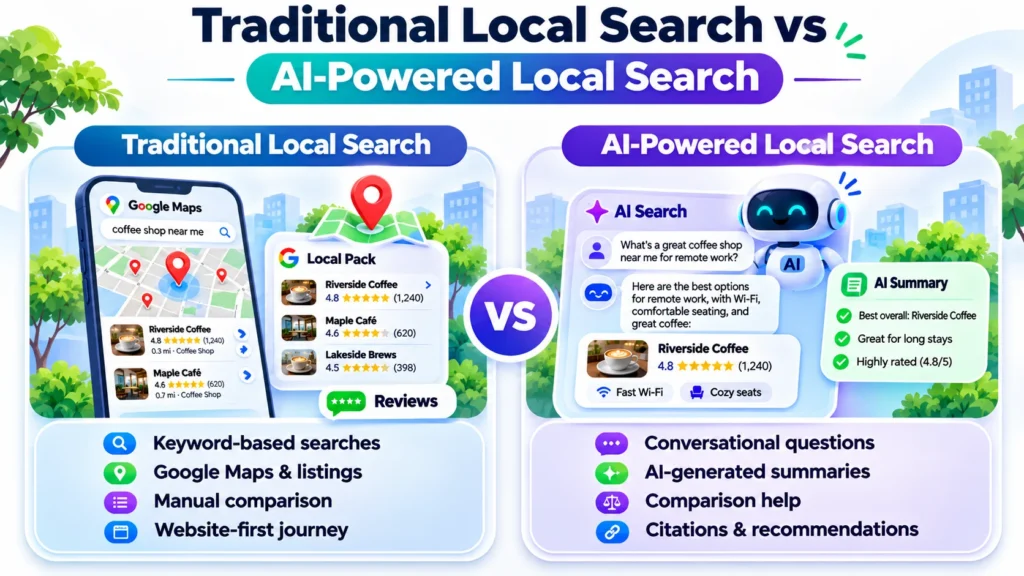
| Area | Traditional Local Search | AI-Powered Local Search |
|---|---|---|
| Search method | Location-based keywords | Conversational questions |
| Results | Google Maps and local listings | Generated recommendations and answers |
| Information | Individual business profiles and websites | Summarized information from available sources |
| Comparison | Users compare listings manually | AI can help summarize differences |
| User journey | Search, visit profiles, contact business | Ask, explore, compare, then take action |
| Visibility | Local rankings and business listings | Mentions, recommendations, and citations |
This does not mean traditional local search is disappearing.
Google Search and Google Maps remain important discovery channels for local businesses. AI-powered experiences add another layer to the way people research and evaluate local providers.
How AI Platforms Discover Local Businesses
Different AI platforms use different systems and information sources.
For example:
Google Search and Google Maps
Google uses information from its Search and Maps ecosystem to help users discover relevant local businesses. Business Profile information, website content, location relevance, and other available signals contribute to local discovery.
ChatGPT
ChatGPT can use web search in supported experiences to retrieve current information and provide links to relevant sources. This creates opportunities for local businesses to be discovered through conversational questions.
Claude
Claude supports web search in applicable experiences, allowing users to investigate current information and review supporting sources.
Perplexity
Perplexity provides search-oriented answers with citations, helping users explore businesses and related information.
One important distinction: appearing in Google Maps does not automatically guarantee that a business will be recommended by ChatGPT, Claude, or Perplexity.
Each platform has its own information retrieval and selection processes.
The most sustainable approach is to make your business information accurate, accessible, relevant, and trustworthy across the wider web.
Why Google Business Profile Still Matters for Local SEO
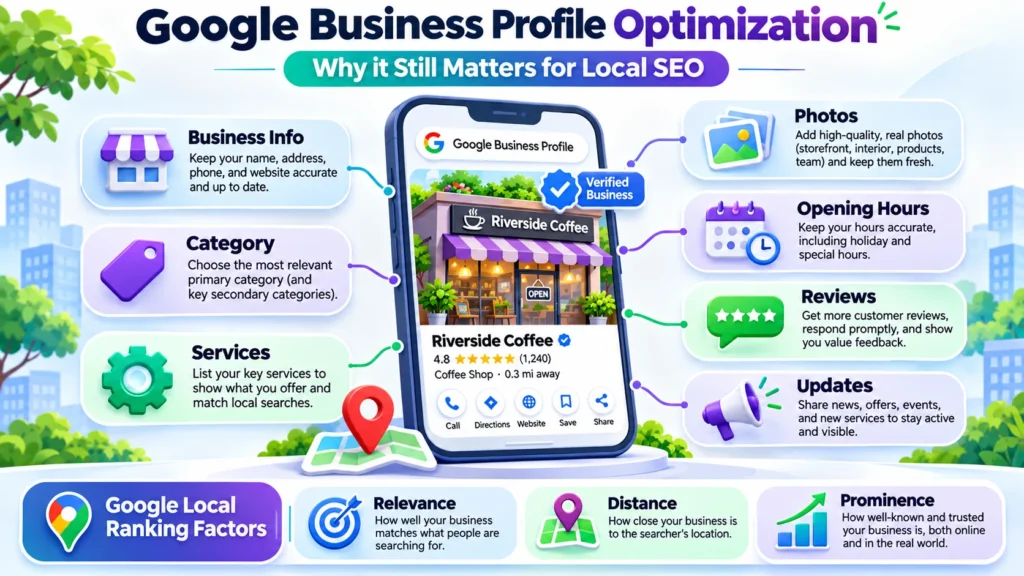
Google Business Profile remains one of the most important tools for businesses that want to improve their visibility in Google Search and Google Maps.
It allows businesses to manage important information that potential customers may need before contacting or visiting them.
This includes:
- Business name.
- Address or service area.
- Phone number.
- Website.
- Business category.
- Services.
- Opening hours.
- Photos and videos.
- Customer reviews.
- Business updates.
Imagine someone searching for an emergency electrician in their area.
They want to know whether the business offers emergency services, whether it is open, how to contact the provider, and whether previous customers have had positive experiences.
If your Google Business Profile is incomplete or outdated, customers may struggle to find the information they need.
How to Optimize Your Google Business Profile
1. Complete Your Business Information
Make sure your business name, address, phone number, website, opening hours, and service information are accurate.
Avoid using unnecessary keywords in your business name. Your profile should reflect your actual business identity.
2. Choose the Most Relevant Business Category
Your primary category should accurately describe your main business activity.
For example, a company primarily offering plumbing services should select an appropriate plumbing-related category rather than choosing an unrelated category simply because it appears popular.
Add relevant secondary categories only when they accurately represent additional services.
3. Add Your Services and Products
Use the available profile features to describe what your business actually provides.
A cleaning company might list:
- Office cleaning.
- Commercial cleaning.
- Industrial cleaning.
- Deep cleaning.
- Carpet cleaning.
Detailed service information helps potential customers understand whether your business meets their requirements.
4. Upload Genuine Business Photos
Use real photos of your premises, team, products, completed projects, and services.
For example, a home renovation company could upload genuine before-and-after project photographs.
Original images provide customers with a better understanding of the business than generic stock photography.
5. Keep Your Opening Hours Updated
Update your regular and special opening hours.
This is particularly important for restaurants, retail businesses, clinics, and emergency service providers.
6. Encourage Genuine Customer Reviews
Ask satisfied customers to share honest feedback about their experience.
Never purchase fake reviews or offer incentives in exchange for positive ratings.
7. Respond to Customer Reviews
Respond professionally to both positive and negative feedback.
Thoughtful responses demonstrate that your business values customer experience and takes feedback seriously.
Google explains that local results are mainly influenced by three factors: relevance, distance, and prominence.
You can read Google’s official guidance on improving local ranking.
Understanding the Three Main Google Local Ranking Factors
One of the most important things local businesses should understand is how Google evaluates local search results.
According to Google, local rankings are primarily based on relevance, distance, and prominence.
1. Relevance
Relevance describes how closely a business profile matches what someone is searching for.
For example, if someone searches for “commercial cleaning services,” a business offering office and industrial cleaning may be more relevant than a company that only provides residential cleaning.
To improve relevance:
- Choose accurate business categories.
- Describe services clearly.
- Complete your Business Profile.
- Create relevant website service pages.
- Provide accurate business information.
2. Distance
Distance refers to how far a business is from the location associated with a customer’s search.
For example, someone searching for “coffee shops near me” may see businesses located close to their current position.
This means a business cannot simply optimize its website to appear equally close to every searcher.
Do not create misleading addresses or virtual locations to manipulate proximity.
Instead, communicate your genuine service areas and physical business location accurately.
3. Prominence
Prominence refers to how well-known a business is.
Google considers information such as links from other websites and customer reviews when determining prominence.
Businesses can work on their reputation by:
- Earning relevant backlinks.
- Building genuine customer reviews.
- Getting mentioned by credible local publications.
- Publishing useful industry information.
- Maintaining a consistent brand presence.
- Demonstrating genuine experience and expertise.
These factors should be developed naturally over time.
There is no legitimate shortcut that guarantees a top position in Google Maps.
How Local SEO, AEO, and GEO Work Together
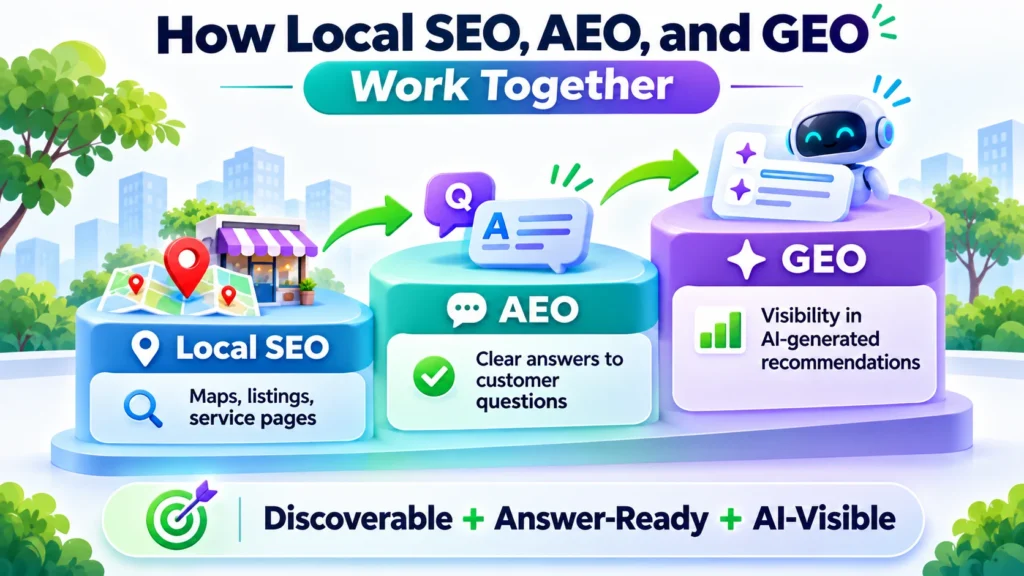
Local SEO, Answer Engine Optimization (AEO), and Generative Engine Optimization (GEO) are often discussed as separate marketing strategies.
However, they share many important principles.
A business needs to be discoverable, understandable, relevant, and credible regardless of whether someone finds it through Google Maps, a traditional search result, or an AI-generated answer.
Local SEO: Build Your Local Search Foundation
Local SEO focuses on improving visibility for location-based searches.
It includes:
- Google Business Profile optimization.
- Local keyword research.
- Location-specific service pages.
- Customer reviews.
- Local backlinks.
- Accurate business information.
- Website optimization.
AEO: Make Your Business Information Easy to Understand
AEO focuses on making information clear and useful for answer-oriented search experiences.
For example, a plumbing company should answer questions such as:
- Do you provide emergency plumbing services?
- Which areas do you cover?
- How much does a plumbing repair cost?
- Do you offer same-day appointments?
- What types of plumbing problems do you handle?
Providing direct, accurate answers helps customers understand your services.
GEO: Build Visibility Across Generative AI Platforms
GEO focuses on improving the visibility of your business and content in generative AI experiences.
This involves building a credible online presence through:
- Useful and accessible website content.
- Consistent business information.
- Genuine brand mentions.
- Relevant third-party references.
- Original expertise.
- Strong topical coverage.
The objective is to make your business easier to discover and evaluate across AI-powered platforms.
The key takeaway: Local SEO builds discoverability, AEO improves answer readiness, and GEO extends your visibility into generative AI experiences.
How to Make Your Local Business More Visible in AI Search
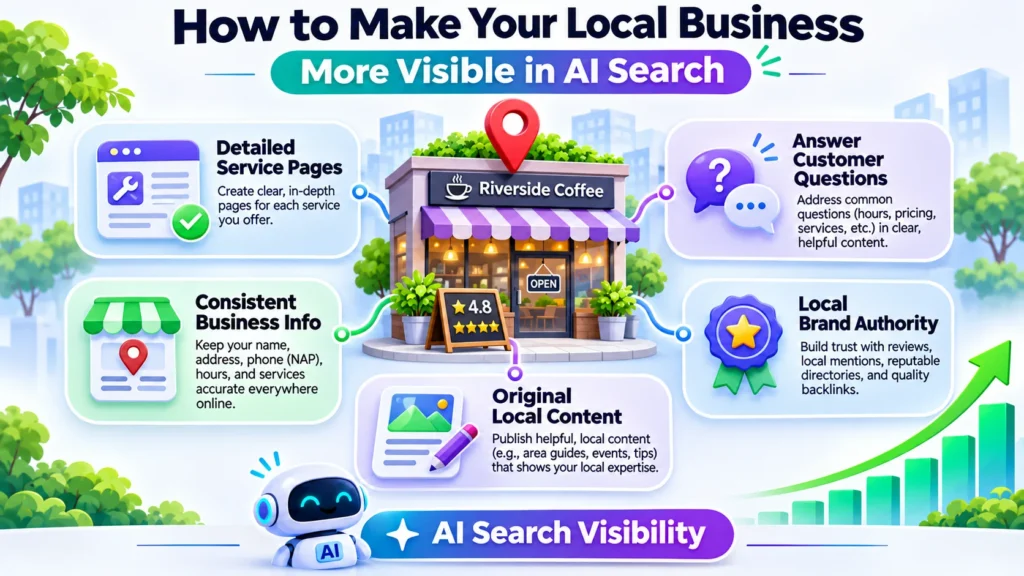
Optimizing a local business for AI search requires more than adding location keywords to website content.
You need to make sure that your business information is accurate, useful, and supported by credible sources.
Here are some practical steps.
1. Create Detailed Location and Service Pages
Your website should clearly explain the services you provide and the locations you genuinely serve.
For example, a Singapore-based air conditioning company might have dedicated pages for:
- Air conditioning installation.
- Air conditioning repair.
- Air conditioning servicing.
- Commercial air conditioning services.
If the business genuinely operates across different locations, relevant location pages may also be useful.
Each page should provide meaningful information about the service and its local relevance.
Avoid creating dozens of nearly identical location pages by simply replacing city names. Such pages provide little value and can create doorway-page or scaled-content risks.
2. Answer Local Customer Questions
Think about the questions customers ask before choosing your business.
A dental clinic might answer:
- What dental treatments are available?
- How much does a dental consultation cost?
- Do you accept new patients?
- What should I bring to my first appointment?
- Where is the clinic located?
An electrician might answer:
- Do you provide emergency electrical repairs?
- Which areas do you serve?
- Can you repair electrical wiring in older homes?
- Do you provide installation services?
- How can customers request a quotation?
Organize these answers under relevant headings on your website.
Give direct answers, but include enough context to make them genuinely useful.
3. Build Consistent Business Information
Your business information should be consistent across your website and relevant external platforms.
Pay attention to:
- Business name.
- Physical address.
- Phone number.
- Website.
- Opening hours.
- Service descriptions.
- Service areas.
This information is particularly important when customers are trying to verify whether different online listings represent the same business.
Use accurate information rather than attempting to manipulate search engines with artificial keyword variations.
4. Strengthen Your Local Brand Authority
A local business should build its reputation beyond its own website.
For example, a Singapore-based renovation company could develop relationships with relevant industry publications, participate in local business communities, and publish useful project insights.
Other opportunities include:
- Local news coverage.
- Relevant industry associations.
- Genuine supplier partnerships.
- Community involvement.
- Customer testimonials.
- Credible local business directories.
- Editorial backlinks.
The objective is to build genuine recognition, not simply generate as many brand mentions as possible.
5. Publish Original Local Content
Generic articles about local services are easy to reproduce.
Businesses can provide more value by sharing real knowledge about their industry and market.
For example, a cleaning company could publish:
- How office cleaning requirements differ across workplaces.
- What businesses should consider before scheduling deep cleaning.
- Common cleaning challenges in commercial properties.
- How to prepare a workplace for professional cleaning.
Use genuine observations, original photographs, and real examples wherever possible.
This gives customers more reasons to trust the business and creates information that is more distinctive than generic promotional content.
Why Online Reviews and Brand Reputation Matter More Than Ever
Customer reviews have always played an important role in local business discovery.
Today, they also provide potential customers with useful information when comparing different providers.
Consider two local cleaning companies.
Company A has a basic website and only a few customer reviews.
Company B has detailed service information, genuine customer feedback, project photographs, and a consistent online presence.
A customer evaluating both companies has more information available about Company B.
This does not guarantee a better Google ranking or an AI recommendation, but it can help customers make more informed decisions.
How to Build a Strong Review Strategy
Ask for Honest Feedback
Invite customers to leave reviews after completing a service or purchase.
Make Reviewing Easy
Provide a direct link to your Google review page.
Respond Professionally
Thank customers for positive feedback and address complaints constructively.
Learn From Reviews
Identify recurring problems and use customer feedback to improve your services.
Avoid Fake Reviews
Do not purchase reviews, create fake customer accounts, or manipulate ratings.
A strong reputation should reflect actual customer experiences.
How to Optimize Your Website for Google Maps, ChatGPT, and Claude
Different search platforms provide different discovery experiences, so businesses should focus on the requirements that apply to each environment.
Google Maps and Local Search
Focus on:
- A verified and complete Google Business Profile.
- Accurate business categories.
- Relevant services.
- Genuine customer reviews.
- Updated operating hours.
- Accurate website and contact information.
- Relevant local website content.
Monitor your performance through Google Business Profile performance reports and Google Search Console.
ChatGPT
ChatGPT can retrieve current web information through its search features.
Businesses should:
- Publish useful and accurate local service information.
- Keep important pages publicly accessible.
- Maintain clear business and contact information.
- Build credible third-party recognition.
- Review access rules for OpenAI’s OAI-SearchBot.
OpenAI distinguishes OAI-SearchBot, which is used for search discovery, from GPTBot, which is associated with model training.
Review the official OpenAI crawler documentation.
Allowing OAI-SearchBot does not guarantee that ChatGPT will recommend or cite your business.
Claude
Claude supports web search in applicable experiences.
To improve discoverability, local businesses should maintain accurate public information, publish useful content, and develop a credible online presence.
Review Anthropic’s official website crawler information.
Perplexity
Perplexity provides search-oriented answers with supporting citations.
Businesses should focus on making important information accessible, accurate, and relevant.
Useful service pages, original industry insights, and credible third-party references can provide valuable context for users researching local businesses.
No platform guarantees visibility simply because a business follows these practices.
The Role of Website Content and Structured Data in Local SEO
Your Google Business Profile is important, but your website also plays a significant role in communicating what your business does.
A well-structured website helps customers understand your services and find relevant information.
It also provides search engines with additional context about your business.
Build Dedicated Service Pages
Each major service should have a dedicated page when it serves a distinct customer need.
For example, an HVAC company might create separate pages for:
- Air conditioning repair.
- Air conditioning installation.
- Air conditioning maintenance.
- Commercial HVAC services.
Each page should explain the service, common customer problems, service process, relevant locations, and contact options.
Use Local Business Structured Data
Structured data can help describe your business information in a standardized format.
Depending on your business, relevant properties may include:
- Business name.
- Address.
- Telephone number.
- URL.
- Opening hours.
- Geographic coordinates.
- Business type.
- Service information.
The LocalBusiness type and its appropriate subtypes can be useful when describing a local business.
However, structured data does not guarantee a higher local ranking or AI citation.
Make sure schema information matches the information visible on your website.
Google’s Local Business structured data documentation provides implementation guidance.
Strengthen Internal Linking
Internal links help visitors discover related services and information.
For example, a plumbing company could connect its main plumbing service page to supporting pages about:
- Emergency plumbing.
- Bathroom plumbing.
- Kitchen plumbing.
- Pipe repairs.
- Water leak detection.
These links create a more useful website structure and help search engines discover related pages.
How to Measure Local SEO and AI Search Performance
Traditional local SEO reporting is important, but businesses should also understand how their brand appears across AI-powered discovery platforms.
A useful measurement strategy should cover three areas.
1. Local SEO Performance
Track:
- Google Business Profile views.
- Search queries.
- Website clicks.
- Calls.
- Direction requests.
- Booking actions.
- Organic website traffic.
- Local keyword rankings.
Remember that Business Profile interactions and website traffic measure different things. A customer may call directly without visiting your website.
2. AEO Performance
Monitor whether your content answers the questions potential customers are asking.
Useful indicators include:
- Visibility for question-based queries.
- Relevant featured snippets where available.
- Direct-answer search appearances.
- Engagement with FAQ and service content.
- Customer questions addressed through your website.
3. GEO Performance
Track:
- Business mentions in ChatGPT responses.
- Website citations in AI-generated answers.
- Brand visibility across relevant local prompts.
- Referral traffic from AI platforms.
- Accuracy of your business information.
- Qualified enquiries from AI-referred visitors.
For example, periodically test questions such as:
“Which companies provide commercial cleaning services in Singapore?”
“Who offers emergency air conditioning repair near [target location]?”
“Recommend a reliable local electrician that provides residential services.”
Record whether your business appears, which sources are cited, and whether the information is accurate.
Repeat the tests because AI responses can change based on prompts, location, platform, and time.
A Practical 90-Day Local SEO Strategy for the AI Era
Businesses do not need to change everything overnight.
A structured 90-day plan can help establish a stronger local search foundation while preparing for AI-powered discovery.
Days 1–30: Fix the Local SEO Foundation
Priorities:
- Complete a local SEO audit.
- Verify and optimize Google Business Profile.
- Correct inaccurate business information.
- Review website indexing and technical SEO.
- Identify primary local keywords.
- Audit existing service and location pages.
- Check customer review management.
Expected outcome: A clearer, more accurate local online presence.
Days 31–60: Improve Content and Local Relevance
Priorities:
- Improve important service pages.
- Develop genuinely useful location-specific content.
- Add answers to common customer questions.
- Implement appropriate LocalBusiness structured data.
- Strengthen internal linking.
- Add genuine project photographs.
- Improve business descriptions and service information.
Expected outcome: More useful website content and stronger local relevance.
Days 61–90: Build Authority and AI Visibility
Priorities:
- Develop relevant local backlinks.
- Earn credible industry mentions.
- Improve customer review management.
- Publish original local industry insights.
- Review AI crawler accessibility.
- Test relevant ChatGPT, Claude, and Perplexity queries.
- Establish local and AI search reporting.
Expected outcome: A stronger foundation for local discovery across traditional and AI-powered search.
These are implementation milestones, not guaranteed ranking or lead-generation deadlines. Results depend on competition, location, business reputation, and website condition.
Common Local SEO Mistakes Businesses Should Avoid
Even businesses with good services can struggle with online visibility because of avoidable optimization mistakes.
1. Keyword Stuffing in Google Business Profile
Adding unnecessary keywords to your business name or description does not create a sustainable local SEO strategy.
Use your genuine business name and accurate service descriptions.
2. Creating Duplicate Location Pages
Publishing dozens of nearly identical city pages provides little value.
Create location pages only when you can offer meaningful, location-specific information.
3. Ignoring Customer Reviews
Reviews are an important part of the customer decision process.
Ignoring feedback can make a business appear less responsive.
4. Using Inaccurate Business Information
Incorrect opening hours, phone numbers, addresses, and service information can confuse potential customers.
Keep important information updated.
5. Publishing Generic AI-Generated Content
AI tools can assist with research and writing, but publishing large volumes of generic articles without useful insights does not establish meaningful authority.
Review content for accuracy and add real business knowledge.
6. Treating GEO as a Separate Shortcut
There is no reliable trick that guarantees your business will appear in ChatGPT or Claude.
Build strong SEO foundations, provide accurate information, and develop genuine brand authority.
Frequently Asked Questions (FAQs)
1. What is local SEO in the age of AI?
Local SEO in the age of AI involves improving a business’s visibility across traditional local search platforms and AI-powered discovery experiences. It combines Google Business Profile optimization, local website content, accurate business information, customer reviews, and brand authority.
2. Is local SEO still important with AI search?
Yes. Local SEO remains important because customers continue to use Google Search and Google Maps to find nearby businesses. AI-powered search adds more ways for customers to discover and evaluate local providers.
3. How is AI changing local SEO?
AI is making local search more conversational and contextual. Customers can describe specific requirements, compare providers, and ask follow-up questions. Businesses therefore need accurate profiles, useful website content, and credible online information.
4. How can my local business appear in ChatGPT recommendations?
Publish accurate service information, maintain accessible website pages, build genuine brand authority, and keep business details consistent. You can also review OpenAI’s search crawler policies. There is no guaranteed way to secure a recommendation.
5. Does Google Business Profile help with AI search?
Google Business Profile is an important source of business information within Google’s Search and Maps ecosystem. Keeping it accurate also helps customers verify your business. However, it does not guarantee that other AI platforms will recommend your company.
6. What are the main local SEO ranking factors?
Google identifies relevance, distance, and prominence as the main factors influencing local results. Businesses can improve their relevance and prominence through accurate business information, genuine reviews, and a strong online presence, while distance depends on the searcher’s location.
7. Do customer reviews improve local SEO?
Google states that more reviews and positive ratings can help local ranking. Reviews also help potential customers understand other people’s experiences. Businesses should encourage genuine feedback and respond professionally.
8. What is the difference between local SEO and GEO?
Local SEO focuses on visibility in location-based search results, including Google Maps. GEO focuses on visibility in generative AI responses. Both benefit from accurate business information, useful content, and genuine brand authority.
9. How long does local SEO take to show results?
There is no fixed timeline. Results depend on competition, location, website condition, business reputation, and the quality of optimization. Some improvements may be visible relatively quickly, while building strong local authority can take longer.
10. Do small businesses need AEO and GEO?
Small businesses can benefit from preparing for answer-oriented and generative AI search experiences. They do not necessarily need separate campaigns. A strong local SEO strategy combined with clear answers and credible business information is a practical starting point.
Final Thoughts: Local Visibility Is About More Than Rankings
The way people discover local businesses is evolving.
Customers are still searching Google and Google Maps, but they are also asking AI assistants to compare services, explore options, and identify suitable providers.
This means local businesses need to think beyond traditional keyword rankings.
A complete strategy should include an accurate Google Business Profile, useful service pages, relevant local content, genuine customer reviews, a strong brand reputation, and a technically accessible website.
Local SEO provides the foundation. AEO helps customers and answer systems understand your business information. GEO extends the focus to visibility across generative AI experiences.
The businesses that prepare for these changes will have more opportunities to connect with customers wherever they choose to search.
The future of local SEO is not about choosing between Google and AI. It is about making your business discoverable, credible, and relevant across the entire search ecosystem.